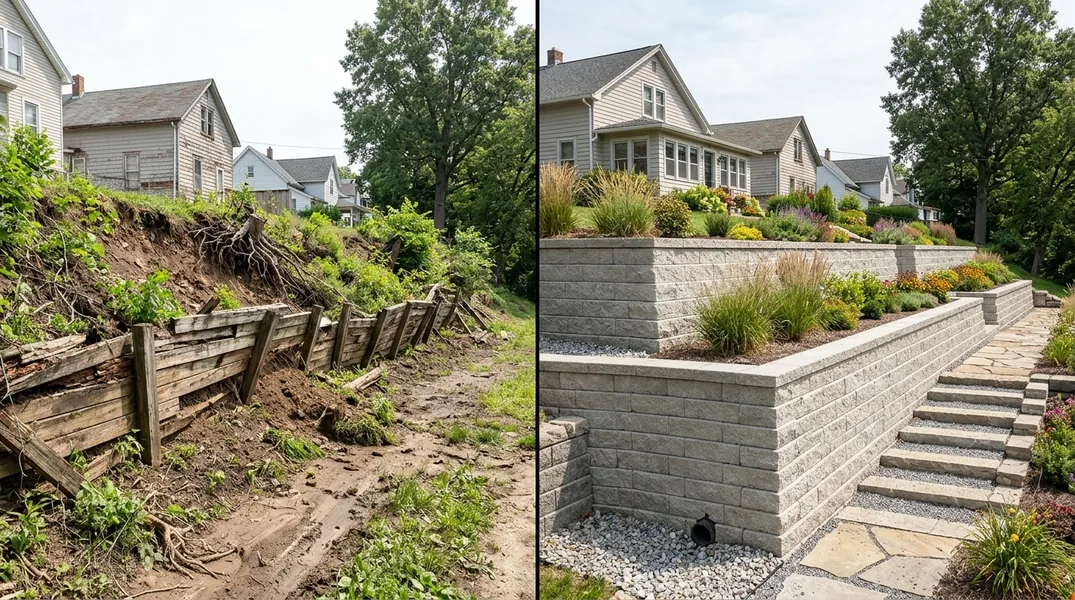
Why Cleveland Winters Are So Hard on Retaining Walls
If you live in Cleveland, you already know that winter here is not just cold. It is a cycle of freezing rain, heavy snow, rapid thaws, and refreezes that puts enormous stress on everything outside your home, including your retaining wall. What many homeowners do not realize is that the most common cause of retaining wall failure in this climate is not the weight of the soil behind the wall. It is water, and the way that water behaves when temperatures drop below freezing.
Two forces work together to destroy walls here: hydrostatic pressure from trapped water and frost heave from freezing ground. Both are directly related to retaining wall drainage, and both are preventable with the right design and materials. Understanding how these forces operate is the first step toward protecting your investment and avoiding a costly Retaining Wall Repair project down the road.
Hydrostatic Pressure: The Silent Force Behind Wall Failure
When rain and snowmelt soak into the soil behind a retaining wall, that water has to go somewhere. If the wall was built without proper drainage, the water becomes trapped in the backfill. As more water accumulates, it creates hydrostatic pressure retaining wall problems, meaning the water pushes outward against the wall with increasing force. A well-built wall is designed to handle the weight of soil, but it is not designed to hold back a saturated sponge of mud and water. Over time, that pressure causes bulging, cracking, leaning, and eventually collapse.
In Lakewood and other older suburbs with clay-heavy soils, the problem is worse. Clay drains very slowly, so water sits against the wall for days or weeks after a storm. Without a retaining wall french drain or a gravel drainage column behind the wall, hydrostatic pressure builds with every rainfall. Homeowners often notice the symptoms first as dampness or efflorescence (white powder) on the wall face, but by then the damage is already underway.
Frost Heave: When Freezing Ground Pushes Walls Apart
Frost heave retaining wall damage is a winter-specific problem that is especially severe in Northeast Ohio. When the ground freezes, water in the soil expands by about nine percent. That expansion lifts the soil, and if the soil is trapped behind a wall, it pushes laterally against the wall with tremendous force. The freeze-thaw cycle repeats many times each winter, so the wall is subjected to repeated stress cycles that gradually weaken mortar joints, shift blocks, and crack concrete.
Frost heave also affects the foundation of the wall. If the base of the wall is not set below the local frost line, the entire structure can lift and settle unevenly. This is why proper depth and base preparation are critical for any Retaining Wall Installation in this region. A wall that looks fine in July can be quietly undermined by January, and the damage often does not become visible until the spring thaw. In Parma and similar areas with expansive clay soils, frost heave can be particularly aggressive.
How Proper Drainage Prevents Winter Damage
The good news is that both hydrostatic pressure and frost heave can be managed with a drainage system designed for our climate. A proper retaining wall french drain typically includes a perforated pipe at the base of the wall, wrapped in filter fabric and surrounded by washed gravel. This collects water before it can build up and directs it away from the wall to a safe discharge point. Behind the wall, a drainage board or gravel column allows water to flow down to the drain rather than saturating the soil.
Weep holes are also essential. These small openings in the wall face allow any remaining water to escape, relieving pressure before it becomes dangerous. When these systems are installed correctly, the soil behind the wall stays drier, which means less hydrostatic pressure in summer and less frost heave in winter. For homeowners considering Concrete Retaining Walls, we always incorporate drainage from day one because concrete is rigid and cannot flex under pressure the way some other materials can.
Signs Your Wall Is Already Failing (and What to Do)
If your wall is already showing signs of trouble, do not wait for spring. Look for leaning or bulging sections, cracks that are wider at the top than the bottom, soil washing out from behind the wall, or water pooling at the base after rain. In Cleveland Heights and other hilly neighborhoods, walls on slopes are especially vulnerable because water drains toward them from above. Any of these symptoms means the wall is under stress and may need professional attention.
In some cases, Retaining Wall Repair can restore the wall by adding drainage, replacing failed sections, or reinforcing the structure. In more severe cases, a full Retaining Wall Replacement may be the safer and more cost-effective option, especially if the original wall was built without drainage. A professional assessment will tell you which path makes sense for your property and your budget. You can request a free estimate to get started.
Retaining Wall Drainage Near Me: When to Call a Pro
Many homeowners try to solve drainage issues by adding a few weep holes or a surface drain, but these quick fixes rarely address the root cause. Proper drainage design requires an understanding of your soil type, the slope of your yard, the height of the wall, and the local frost depth. A contractor who works in Cleveland every day knows how these factors interact and can design a system that will hold up through decades of freeze-thaw cycles.
If you are unsure whether your wall has adequate drainage, or if you are planning a new wall and want to avoid the mistakes that lead to early failure, call Cleveland Retaining Wall at (216) 640-7629. We can evaluate your existing wall, explain your options, and provide clear pricing before any work begins. Do not let another Cleveland winter test a wall that was never built to handle it.
Looking for a professional retaining wall contractor in Cleveland? Cleveland Retaining Wall responds fast for all your retaining wall needs.
Get a Free QuoteOur services: Retaining Wall Installation · Retaining Wall Repair · Retaining Wall Replacement