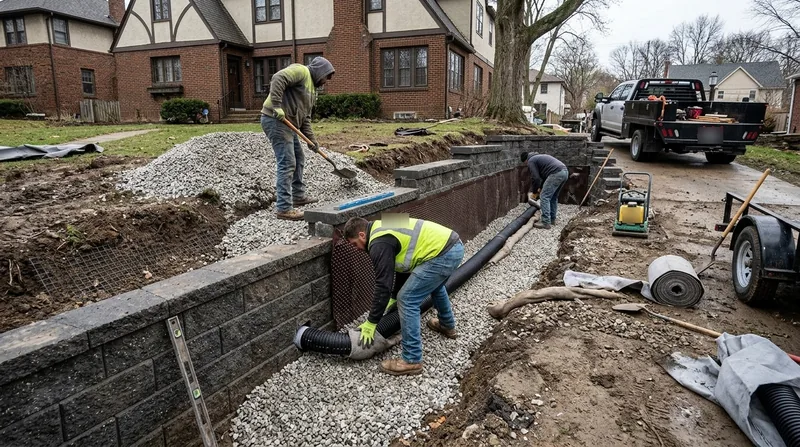




Retaining Wall Drainage in Cleveland
Cleveland sits on a flat lake plain cut by steep ravines along the Cuyahoga, Rocky River, Big Creek and Doan Brook, and that geology drives almost every wall failure we see. The ground here is dense glacial clay and till, and the water table sits high. Water soaks into that clay and stops, and it pushes hard against the back of every wall. Retaining Wall Drainage in Cleveland is the work that gives that water somewhere to go before it cracks, tips, or bulges your wall. We install French drains, weep holes, gravel backfill and waterproofing on the old Berea sandstone block walls in Tremont, the poured concrete driveway walls in Parma, and the segmental block terraces in Shaker Heights. If your wall is already leaning, start with leaning and collapsed wall repair before the drainage work.
Why Drainage Decides Whether a Cleveland Wall Survives
Hydrostatic pressure is the number one cause of retaining wall failure in this city, and the freeze-thaw cycle makes it worse every winter. Water trapped behind a wall freezes, expands, and shoves the wall out of line. Lake-effect snow melts into saturated clay in March, and that is when most of our collapse calls come in. A wall with no drainage is a wall on a countdown, whether it is a 1920s sandstone block wall in Ohio City or a 1970s railroad tie wall in Mentor.
- Saturated clay backfill adds enormous lateral load that most residential walls were never built to carry.
- Freeze-thaw cycles open joints in CMU and sandstone walls, and water then pours straight into the core.
- Weep holes clog with clay fines within a few seasons if there is no gravel behind them.
- Water running over the wall face erodes the slope below and undermines the footing.
- Tree roots along ravine lots in Cleveland Heights push through failed drainage and crack the wall face.
Every one of those failure modes is cheaper to prevent with drainage than to fix after the wall moves.
Key info: On a Lakewood lot near the bluffs, we pulled a poured concrete wall that had bulged 4 inches in five years. The backfill was pure clay with one clogged weep hole. A proper drain and gravel backfill would have cost a fraction of the rebuild.
For the engineering side of wall loads and drainage, the Office of Surface Mining Reclamation and Enforcement publishes free technical guidance on retaining structures and slope drainage that is worth a read.
How We Relieve Water Pressure Behind a Cleveland Wall
We start by digging out the wall face and exposing the backfill so we can see where the water actually sits. On most Cleveland jobs, that means removing the top course or a section of wall, not guessing from the surface. Then we build a drainage path that will still work in ten years, not just after the next rain.
- We excavate behind the wall to the footing and remove saturated clay and any failed drainage fabric.
- We line the trench with filter fabric so clay fines cannot clog the stone.
- We set a perforated French drain pipe at the low point and pitch it to daylight or a storm connection.
- We backfill with washed gravel and wrap the stone in fabric to keep the drain clean.
- We core clean weep holes through concrete and CMU walls at the footing and space them correctly.
- We apply waterproofing membrane or drainage board to the wall face before backfilling.
- We restore the wall, cap it, and test the drain with a hose before we leave.
That sequence is the same whether the wall is 3 feet or 12 feet tall, and it is what separates a drain that works from a gravel trench that silts up in two seasons.
Key info: A homeowner in Cleveland Heights had water pouring through the face of a sandstone terrace wall every spring. We reset the drain, added gravel backfill and new weep holes, and the wall has stayed dry and plumb through three winters.
Drainage Approaches We Use on Cleveland Walls
The right system depends on the wall material, the height, and where the water can safely discharge. On a tight lot in Slavic Village, discharge to daylight may mean routing to a storm drain or a dry well. On a ravine lot in Bay Village, gravity often does the work for us.
| Approach | Description | Best for |
|---|---|---|
| French drain behind the wall | Perforated pipe in washed gravel, wrapped in filter fabric, pitched to daylight | Most residential walls with clay backfill |
| Weep holes and gravel backfill | Cored holes at the footing with clean stone behind the wall face | Poured concrete and CMU walls |
| Waterproofing membrane and drainage board | Membrane on the wall face with a dimpled board that channels water down | Walls below grade or under a driveway |
| Surface and slope drainage | Regrading, swales and downspout extensions that keep water off the wall | Ravine lots and tiered walls |
| Dry well or storm connection | A discharge point when the lot has no gravity outlet | Flat lake-plain lots with no daylight |
We size the pipe and stone volume to the wall height and the drainage area above it, not to a one-size rule of thumb.
Retaining Wall Drainage Cost in Cleveland: What to Expect
Drainage work starts at $2,500 for a straightforward residential wall with a French drain, gravel backfill and weep holes. From there, the price moves with wall length, height, how much clay has to come out, and how far the water has to travel to a discharge point. A 40-foot poured concrete driveway wall in Parma is a different job from a tiered segmental terrace in Shaker Heights.
- Wall length and height drive the pipe, stone and labor quantities.
- Access matters: a wall behind a narrow Tremont lot costs more to dig than one beside a driveway.
- Discharge options (daylight, storm connection, dry well) add cost when gravity is not available.
- Walls that are already leaning may need repair before drainage can be installed.
- Winter work costs more because frozen ground slows excavation.
Get two or three written estimates and compare scope, not just the bottom line. You can see how we break down jobs on our pricing page.
What to Look For in a Retaining Wall Contractor Near Cleveland
Drainage is invisible once the wall is backfilled, so hire someone who will show you the work before it disappears. Ask for proof of licensing and insurance, and get the certificate sent to you directly. Ask for references on walls similar to yours, in similar soil, and call them.
- Confirm the contractor is fully insured, and ask for a certificate of insurance.
- Get at least two or three written estimates with a clear scope of drainage work.
- Ask whether a permit is required for your wall height and check with the local building department.
- Ask how they will handle tree roots and whether any trees need protection during excavation.
- Check HOA rules before you schedule work, especially on tiered walls visible from the street.
If a contractor will not put the drainage details in writing, keep looking. You can reach us through our contact page for a free estimate.
Retaining Wall Drainage Near Me: What Cleveland Homeowners Should Know
When you search for retaining wall drainage near me, you want a crew that knows Cleveland soil, not a generic drain installer. The failure pattern here is specific: clay backfill, a high water table, and freeze-thaw that opens every joint. We see it on the old sandstone walls in Tremont and Ohio City, the CMU driveway walls in Parma, and the railroad tie walls in Mentor that are already rotting from the inside.
A drainage job done right includes a filter fabric barrier, washed stone, a pitched perforated pipe, and a discharge point that actually works in a Cleveland spring. If your wall is already failing, our retaining wall repair crew can stabilize it before we address the water. For walls that are too far gone, retaining wall replacement with proper drainage built in is the durable fix.
Call (216) 640-7629 to schedule a free estimate. We serve Cleveland and the surrounding suburbs, and we will tell you straight whether your wall needs drainage alone or more.
Retaining Wall Drainage in Cleveland: Pricing Guide
| Service | Price | Details |
|---|---|---|
| Basic French drain and weep holes | Starting at $2,500 | Includes excavation, filter fabric, perforated pipe, washed gravel backfill and cored weep holes on a standard residential wall. |
| Full drainage retrofit with waterproofing | Starting at $4,500 | Adds membrane or drainage board on the wall face and a new discharge route, priced by wall length and access. |
| Tiered or tall wall drainage system | Starting at $7,500 | Multiple drain runs and engineered outlets for tiered walls or walls above 4 feet with heavy surcharge. |
| Complex or large-scale job | On estimate | Ravine lots, tight access, storm connections or walls needing repair first require an on-site look before pricing. |
| Travel | Included | In Cleveland and surrounding areas, no separate call-out or mileage fee. |
| Estimate | Free | Response within 24h at (216) 640-7629, no obligation to book. |
Indicative pricing, the exact cost depends on square footage, finish, and site access. Free personalized estimate within 24h at (216) 640-7629.


