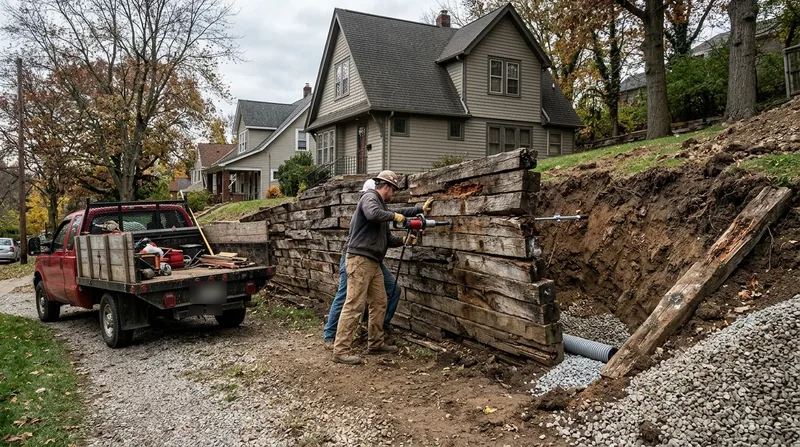




You can spot a failing wall from the sidewalk in Cleveland. The top courses step out, the face bulges after a wet spring, or a section has already slumped into the yard. If you need Leaning & Collapsed Wall Repair in Cleveland, the cause is almost always the same: water trapped behind dense glacial clay and till, combined with relentless freeze-thaw cycles that shove walls out of line season after season. Our crews stabilize, re-drain, and rebuild walls across the city, from the narrow lots of Tremont and Slavic Village to the wooded slopes of Cleveland Heights and the lakefront bluffs in Lakewood and Bay Village. We work priority calls first and tell you straight whether your wall can be saved or needs a rebuild. For walls that are past repair, see our retaining wall replacement service.
Why Leaning and Collapsed Walls Are a Cleveland Problem, Not a Cosmetic One
Most of Cleveland sits on flat lake plain cut by steep ravines along the Cuyahoga, Rocky River, Big Creek, and Doan Brook. That terrain, plus a high water table and heavy clay, means water has nowhere to go. It saturates the backfill, freezes, expands, and pushes the wall face outward. Add lake-effect snowmelt and you get the failure mode that dominates here: hydrostatic pressure combined with frost heave, not erosion from rain alone.
- Older Berea sandstone block walls in Tremont and Ohio City were often built without proper footing drains, so they lean once the clay behind them stays wet.
- Poured concrete and CMU driveway walls in Parma and Strongsville crack and rotate when downspouts dump roof water directly behind them.
- Segmental block terraces on the rolling lots in Cleveland Heights and Shaker Heights bulge at the base when the drain gravel clogs with fines.
- 1970s railroad tie walls throughout the inner-ring suburbs rot from the back, lose their tiebacks, and collapse without warning.
A leaning wall is a structural warning, not a landscaping nuisance. Once the face kicks out past a few inches, the wall is carrying load it was never designed for, and the next freeze can take it down.
Key info: A wall in Bay Village that leans toward the house after a wet winter is usually holding saturated clay against a failing footing drain. Stabilizing it before the next freeze-thaw cycle costs a fraction of rebuilding it after collapse.
Local building departments regulate walls above roughly 4 feet from the footing, or any wall carrying a driveway or structure surcharge, so check with your city before work starts. The Ohio Department of Commerce also maintains contractor licensing resources you can verify before hiring.
How We Stabilize and Rebuild a Failing Wall in Cleveland
We start by finding out why the wall moved, because a lean caused by water needs a different fix than a lean caused by a rotten timber or a washed-out footing. On most Cleveland jobs we open the wall, relieve the pressure, correct the drainage, and then decide whether anchors or a partial rebuild will hold it. We do not patch a face and call it repaired.
- We inspect the wall, footing, and soil, and check for water sources such as downspouts, sump discharges, and uphill grade.
- We relieve hydrostatic pressure by clearing or replacing the drain gravel, perforated pipe, and filter fabric behind the wall.
- We install tieback anchors or helical soil nails to pull a leaning wall back to line where the structure is sound enough to save.
- We rebuild failed sections with proper base, compaction, and drainage, matching the existing block, stone, or concrete where possible.
- We restore the grade and surface drainage so water runs away from the wall instead of into it.
Every repair ends with a drainage correction, because without it the same pressure returns with the next wet season.
Key info: On a Shaker Heights terrace wall, the block face had bulged four inches after years of clogged drain gravel. We tied the wall back, replaced the drainage behind it, and reset the top courses without tearing out the whole terrace. See how we handle similar work in Cleveland Heights (44118).
Repair Methods We Use and When Each One Fits
The right approach depends on how far the wall has moved, what it is built from, and what it holds back. We choose the least invasive method that will actually solve the problem, and we tell you when a rebuild is the honest answer.
| Approach | Description | Best for |
|---|---|---|
| Tieback anchors | Steel anchors driven into stable soil behind the wall and tensioned to pull the face back to line. | Leaning block, concrete, or stone walls with sound structure but failing lateral support. |
| Drainage correction | Replacing clogged gravel, perforated pipe, and filter fabric to relieve hydrostatic pressure. | Bulging walls on clay soils where water is the main driver. |
| Partial rebuild | Removing and rebuilding the failed section with a new base, compaction, and drainage. | Walls with a collapsed section or a footing that has washed out. |
| Full rebuild | Tearing out the wall and rebuilding with an engineered base and drainage system. | Rotten timber walls, shattered CMU, or walls that have moved past anchoring. |
| Soil nail and shotcrete | Reinforcing the slope face with soil nails and a structural facing for steep ravine sites. | Ravine-edge walls along the Cuyahoga and Rocky River where access is tight. |
We match the method to the wall, not the other way around, and we explain the tradeoffs before you commit.
Leaning & Collapsed Wall Repair Cost in Cleveland: What to Expect
Most leaning and collapsed wall repairs in Cleveland start around $2,500, and that figure covers stabilization and drainage work on a typical residential wall. The price climbs with wall height, length, access, and how much of the wall has actually failed. A short garden wall in Parma is a different job from a tall lakefront wall in Bay Village that needs anchors and an engineered design.
Several factors move the number: the wall material and whether matching block or stone is available, the slope and how tight the equipment access is, whether the footing is intact, and whether the wall carries a driveway or structure. Urgency matters too, since a wall that is actively collapsing needs shoring before anything else happens. We recommend getting two or three written estimates on any wall repair, and we are glad to walk you through ours line by line. For a broader look at how we price work, see our pricing overview.
What to Look For When Hiring a Retaining Wall Contractor Near Cleveland
Wall repair is structural work, and the wrong contractor can leave you with a wall that leans again after the next freeze. Ask for proof of licensing and insurance before anyone touches the wall, and confirm the policy covers excavation and structural work, not just general labor. Get at least three estimates and compare what each one includes, because a low bid that skips drainage is not a repair.
Check references on similar walls in similar soil, and ask how the contractor handles permits. Many Cleveland-area jurisdictions require a permit for walls above roughly 4 feet from the footing or when the wall supports a surcharge, and some require engineered drawings for tall or tiered walls. If your property is in a historic district or has HOA rules, confirm the contractor has worked under those conditions before. You can reach us through our contact page to schedule a free estimate and verify our credentials.
Finally, ask what happens after the repair. A contractor who corrects drainage and explains how to keep water away from the wall is protecting the repair, not just selling the job.
Leaning & Collapsed Wall Repair in Cleveland: Pricing Guide
| Service | Price | Details |
|---|---|---|
| Leaning wall stabilization with tieback anchors | Starting at $2,500 | Includes anchor installation and drainage check; wall height and access move the price. |
| Drainage correction behind an existing wall | Starting at $2,500 | Covers gravel, pipe, and filter fabric replacement; wall length and excavation depth raise the cost. |
| Partial wall section rebuild | Starting at $3,800 | Includes new base, compaction, and drainage for the failed section; footing condition drives the number. |
| Full wall rebuild after collapse | On estimate | Needs an on-site look at footing, soil, and access before a number is given. |
| Travel | Included | in Cleveland and surrounding areas, no separate call-out or mileage fee. |
| Estimate | Free | Response within 24h at (216) 640-7629, no obligation to book. |
Indicative pricing, the exact cost depends on square footage, finish, and site access. Free personalized estimate within 24h at (216) 640-7629.


