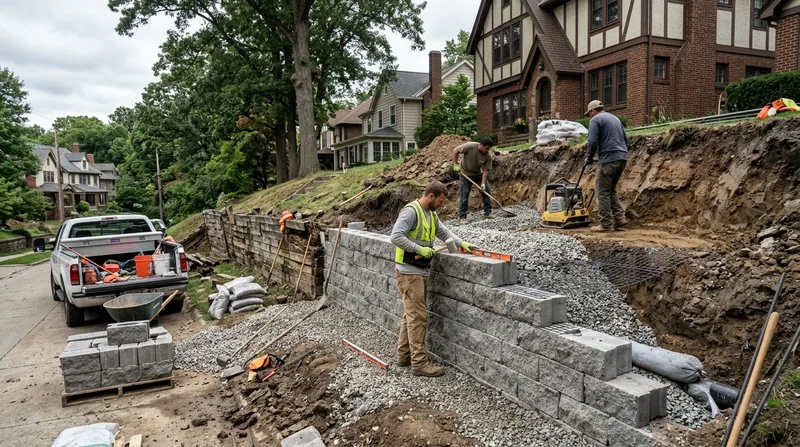




Retaining Wall Installation in Cleveland means building a wall that holds against dense glacial clay, a high water table and relentless freeze-thaw cycles, not just stacking block on a slope. This city sits on a flat lake plain cut by steep ravines along the Cuyahoga, Rocky River, Big Creek and Doan Brook, and that terrain decides how a wall has to be built. Tremont, Ohio City and Slavic Village have narrow lots filled with 1900s frame doubles and workers' cottages where a failed wall crowds the driveway. Cleveland Heights and Shaker Heights sit on rolling, wooded lots where Tudors and Colonial Revivals need terraced walls to hold usable yard. Lakewood and Bay Village lakefront homes face the bluffs, and postwar bungalows and ranches in Parma, Strongsville and Mentor need walls that survive the same clay. We design and build walls with frost-depth footings, gravel backfill and real drainage, because a wall that ignores water will lean within a few winters. If you already have a wall pushing out of line, start with retaining wall repair before the problem spreads.
Why Retaining Wall Installation in Cleveland Is a Different Job Than It Looks
Cleveland's soil is the first thing any wall has to beat. Dense glacial till and clay hold water instead of draining it, and the water table sits high through much of the city. Add lake-effect snow, hard frost and repeated freeze-thaw, and a wall built without proper footing depth and backfill drainage will move. The dominant failure here is frost heave and hydrostatic pressure pushing walls out of line, not coastal erosion or salt air. Old Berea sandstone block walls, poured concrete and CMU driveway walls, segmental block terraces and rotting 1970s railroad tie walls all show the same pattern.
- We excavate to frost depth so the footing sits below the frost line and does not lift each winter.
- We install gravel backfill and drainage pipe so clay soil cannot trap water behind the wall.
- We size the wall for the surcharge, whether it holds a garden terrace or a driveway above it.
- We build in sections and tie tiers together on ravine lots where the slope keeps moving.
- We verify setbacks and permit thresholds with the local building department before we dig.
Every wall we build in Cleveland is designed around the water it will face, not just the load it carries.
Key info: In Cleveland Heights and Shaker Heights, wooded ravine lots often need a tiered wall system rather than one tall wall. We check the slope, the soil and the drainage path first, then design the tiers so each one carries its own load.
Before any wall goes in, confirm local permit thresholds with the City of Cleveland's building department, since walls above roughly four feet or walls supporting a surcharge usually require a permit and sometimes engineered drawings: City of Cleveland.
How We Build a Retaining Wall in Cleveland, Step by Step
We start on site, not on paper. A wall that holds in Cleveland clay depends on reading the slope, the water path and the access before choosing a material. We walk the lot, check where water runs during a thaw, and confirm what the wall has to hold back. Then we match the approach to the job, whether that is segmental block, poured concrete, boulder or timber. Each step below is how we keep a wall plumb through freeze-thaw instead of chasing it after it leans.
- We inspect the slope, soil and drainage path and measure the wall height from the proposed footing.
- We confirm permit requirements and setbacks with the local building department.
- We excavate to frost depth and compact a gravel base before any block or concrete goes down.
- We set drainage pipe and gravel backfill behind the wall so water exits instead of pushing.
- We build the wall in lifts and check plumb and line as we go.
- We backfill, compact and finish the grade so surface water runs away from the wall.
That sequence is why a wall we build in Parma or Strongsville stays put through the spring thaw.
Key info: On a Bay Village bluff lot, we built a tiered boulder wall with gravel backfill and a drainage outlet at each tier. The lakefront slope drains toward the bluff, so the wall had to move water down and out rather than trap it behind the stone.
For terraced gardens and driveway walls in Lakewood and Westlake, see our block and segmental retaining wall work.
Retaining Wall Approaches We Use Across Cleveland
The right material depends on height, load, access and how the wall has to look. A garden terrace in Cleveland Heights and a driveway wall in Parma are not the same job, even at the same height. We pick the approach that fits the site and the budget, then build it for Cleveland clay and frost.
| Approach | Description | Best for |
|---|---|---|
| Segmental block | Interlocking block with gravel backfill and drainage, built in lifts. | Terraced gardens and driveway walls in Parma and Strongsville. |
| Poured concrete | Reinforced concrete wall with a frost-depth footing and weep drainage. | Tall walls and walls carrying a structure or driveway surcharge. |
| Boulder and natural stone | Stone set into the slope with gravel backfill for drainage. | Ravine and bluff lots in Bay Village and Cleveland Heights. |
| Timber | Pressure-treated timber with deadmen and gravel backfill. | Low garden walls and replacing old railroad tie walls. |
We match the material to the load and the soil, so the wall works with the site instead of fighting it.
Retaining Wall Installation Cost in Cleveland: What to Expect
Most Cleveland retaining wall installation starts around $30 per square foot of wall face, and that figure moves with height, material, access and drainage. A low garden wall in Mentor costs less per square foot than a tall tiered wall on a ravine lot in Cleveland Heights, because excavation, backfill and engineering all grow. Tight lots in Tremont and Ohio City add cost when equipment cannot reach the wall. Walls that carry a driveway or structure need heavier footings and often engineered drawings. We quote from the site, not from a phone estimate, so the number reflects what the wall actually has to do. See the full retaining wall pricing overview for detail.
Getting two or three estimates is smart, and not because the cheapest is best. Ask each contractor how they handle frost depth, backfill drainage and surcharge, and compare those answers, not just the total.
What to Look For When Hiring a Retaining Wall Contractor Near Me in Cleveland
Hiring for a retaining wall near Cleveland comes down to proof, not promises. Ask for the license and insurance certificate, and confirm the coverage is current before work starts. Ask for references on walls of similar height and soil, and call them. Confirm who pulls the permit and whether the wall needs engineered drawings. Check setback and property-line rules before the layout is set, and check HOA requirements if you live in a planned community. A contractor who answers these questions plainly is the one to hire.
Reach out through our contact page to set up a site visit.
Retaining Wall Installation Near Me: Timing and Season in Cleveland
Cleveland's building season runs from spring through late fall, and the freeze-thaw cycle sets the schedule. The failure mode that dominates here is frost heave and hydrostatic pressure from clay soil, which shows up as walls leaning and bowing after winter. Late fall and early spring are when homeowners call about a wall that moved, and that is also when we see the most repair and replacement work. New installation is best planned for late spring through early fall, when excavation and backfill compact properly. If a wall is already leaning, do not wait for the thaw to get worse. Call Cleveland Retaining Wall at (216) 640-7629.
Retaining Wall Installation in Cleveland: Pricing Guide
| Service | Price | Details |
|---|---|---|
| Low garden wall | Starting at $30/sq ft | Segmental block or timber wall up to about three feet, with gravel backfill and basic drainage included. |
| Driveway or terrace wall | Starting at $45/sq ft | Taller wall carrying a surcharge, with heavier footing, drainage pipe and compacted backfill included. |
| Boulder or natural stone wall | Starting at $55/sq ft | Stone set into a ravine or bluff slope, with gravel backfill and drainage outlets at each tier. |
| Tiered or engineered wall | On estimate | Tiered systems and walls needing engineered drawings require an on-site look before we quote. |
| Travel | Included | In Cleveland and surrounding areas, no separate call-out or mileage fee. |
| Estimate | Free | Response within 24h at (216) 640-7629, no obligation to book. |
Indicative pricing, the exact cost depends on square footage, finish, and site access. Free personalized estimate within 24h at (216) 640-7629.


