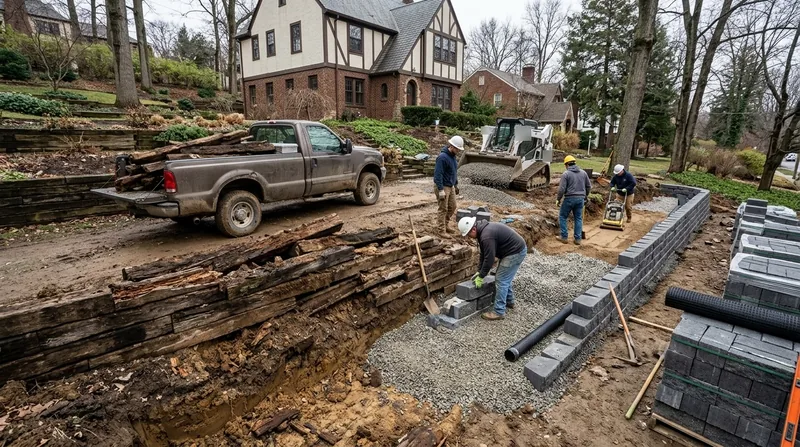




Retaining Wall Replacement in Cleveland
Cleveland sits on a flat lake plain cut by steep ravines along the Cuyahoga, Rocky River, Big Creek and Doan Brook, and that terrain is hard on walls. Dense glacial clay and till hold water, the water table runs high, and lake-effect snow feeds relentless freeze-thaw cycles that push old walls out of line every winter. If you own a home in Tremont, Ohio City or Slavic Village, you likely have a 1920s poured concrete or Berea sandstone block wall behind the garage. In Cleveland Heights and Shaker Heights, the wooded rolling lots carry segmental block terraces that have settled. Along the Lake Erie bluffs in Lakewood and Bay Village, the lakefront walls take the worst of it. Retaining Wall Replacement in Cleveland means tearing out a wall that has reached the end of its life and building a drained, engineered structure that fits the lot and the soil. We handle the tear-out, haul-away and rebuild, and we do it before a leaning wall turns into a collapsed one. If your wall is still repairable, see our retaining wall repair service before you commit to a full replacement.
Why Cleveland Walls Fail and When Replacement Beats Repair
Most of the walls we tear out in Cleveland failed for the same reason: water. Glacial clay does not drain, so hydrostatic pressure builds behind the wall through every spring thaw. Add freeze-thaw that heaves footings and opens joints, and a wall that looked fine five years ago is now leaning into the driveway. Poured concrete and CMU driveway walls from the 1950s and 1960s crack and rotate. The 1970s railroad tie walls through Parma, Strongsville and Mentor are rotting from the inside out, and no amount of patching brings them back.
- The wall leans more than a few inches out of plumb over its height.
- Ties, timbers or block courses show rot, spalling or missing units.
- The footing has heaved or settled from freeze-thaw movement.
- Water pools behind the wall and weeps through the face after rain.
- The wall holds up a driveway, patio or structure and cannot be braced.
When two or more of those show up, replacement is usually cheaper than repeated repairs. Cleveland building departments generally require a permit for walls above roughly 4 feet from the footing, or any wall carrying a surcharge like a driveway or structure, and taller or tiered walls may need engineered drawings. Verify the threshold with your local building department before work starts.
Key info: A 1970s railroad tie wall on a Slavic Village lot is a classic replacement case. The ties rot at the soil line, the wall bulges, and the original drainage is a single gravel trench at best. We tear it out and rebuild with segmental block and a proper drain.
For the code side, the City of Cleveland Department of Building and Housing publishes permit requirements, and the Ohio Construction Industry Licensing Board handles contractor licensing questions.
How We Replace a Failed Wall in Cleveland, Step by Step
Replacement is demolition first, then drainage, then structure. We start by protecting the lawn, driveway and any plantings worth saving, then we cut out the old wall down to the footing. On tight Tremont and Ohio City lots, that means hand work and a small machine, not a full-size excavator in the side yard. Every step is built around the clay and the water table, because that is what took the old wall down.
- We walk the site and check the wall height, soil, drainage path and any utility locates.
- We pull the permit and confirm setbacks and property-line rules with the local building department.
- We demolish the old wall and haul away concrete, block, timber or tie debris.
- We excavate to stable soil and build a compacted gravel base and footing.
- We install perforated drain pipe, washed stone and filter fabric behind the new wall.
- We set the new wall, either segmental block, poured concrete, boulder or timber, with proper batter and geogrid where needed.
- We backfill in lifts, compact, and restore the grade, lawn and any damaged hardscape.
Every replacement ends with a drainage check, because a wall built without a drain in this clay will fail again within a decade. See how we handle retaining wall drainage on its own page.
Key info: On a Cleveland Heights lot off Cedar Hill, a 60-foot segmental block terrace had settled two courses and was pushing against the garage. We tore it out, rebuilt the base on compacted gravel, added a full drain to daylight at the ravine, and reset the block with geogrid. The garage stopped moving.
Replacement Methods We Use in Cleveland
The right replacement material depends on the load, the slope and the look you want. We match the method to the wall, not the other way around, and we tell you plainly when a cheaper option will not hold on your lot.
| Approach | Description | Best for |
|---|---|---|
| Segmental block replacement | Engineered block with gravel base, drain and geogrid on taller walls. | Garden terraces and driveway walls up to and above 4 feet. |
| Poured concrete replacement | Formed and reinforced wall with a drained backfill. | Long straight walls carrying a surcharge or structure. |
| Boulder and natural stone | Rock wall set into the slope with proper batter and drainage. | Ravine lots and wooded yards in Cleveland Heights and Shaker Heights. |
| Timber and tie replacement | Rotting tie or timber wall torn out and rebuilt in the same footprint. | Low garden walls in Parma, Strongsville and Mentor. |
| Tiered wall rebuild | Multiple short walls with benches, drainage and geogrid per tier. | Steep ravine lots where one tall wall is not practical. |
If you are weighing materials, our block and segmental wall service covers the most common replacement, and boulder and natural stone walls fit the ravine lots best.
Retaining Wall Replacement Cost in Cleveland: What to Expect
Replacement pricing starts at From $35/sq ft for a standard segmental block wall with drainage. That figure covers tear-out, haul-away, base, drain and the new wall face. What moves the number is access, wall height, soil conditions and what the wall is holding up. A wall behind a Slavic Village garage with a narrow side yard costs more per foot than an open driveway wall in Strongsville, because the machine cannot get in and the debris goes out by hand.
Height is the other big factor. A wall over 4 feet usually needs a permit and sometimes engineered drawings, which adds design cost. Boulder walls cost more than block because the stone and setting labor are heavier. Poured concrete runs higher than block on long walls but can be cheaper on complex shapes. Rotting tie walls are usually the cheapest to replace because the old material comes out fast.
Get two or three written estimates, and make sure each one spells out drainage, base depth, haul-away and permit handling. A low bid that skips the drain is not a lower price, it is a wall that fails again. Our full pricing overview breaks down what each line item covers.
Choosing a Retaining Wall Replacement Contractor Near Me in Cleveland
Replacement is a structural job, so the contractor matters more than the material. Ask for proof of licensing and insurance before anyone touches the wall, and get a certificate of insurance sent directly from the carrier. Check references on jobs similar to yours, especially walls over 4 feet or walls holding a driveway. Confirm who pulls the permit, because in most Cleveland-area jurisdictions the homeowner can be on the hook if the contractor skips it. If you are in an HOA, get the architectural approval in writing before demolition starts.
- Get two or three itemized written estimates, not verbal ballparks.
- Ask for references on walls of similar height and load.
- Confirm the permit is pulled in the right name before work begins.
- Check HOA or historic district rules if your home is in one.
Reach out through our contact page to set up a free estimate at (216) 640-7629. For city-specific pages, start with replacement in Lakewood or replacement in Parma.
Retaining Wall Replacement in Cleveland: Pricing Guide
| Service | Price | Details |
|---|---|---|
| Segmental block wall replacement | Starting at $35/sq ft | Includes tear-out, haul-away, gravel base, drain and new block; access and wall height move the price. |
| Railroad tie and timber wall replacement | Starting at $30/sq ft | Covers old tie removal, disposal and rebuild in the same footprint; rot depth and soil moisture affect cost. |
| Poured concrete wall replacement | Starting at $55/sq ft | Formed and reinforced wall with drained backfill; surcharge loads and wall length raise the figure. |
| Boulder and natural stone replacement | Starting at $65/sq ft | Heavy stone setting and machine access; ravine lots and tight side yards cost more per foot. |
| Complex or large-scale job | On estimate | Tiered walls, engineered drawings, tight lots or walls holding a structure need an on-site look first. |
| Estimate | Free | Response within 24h at (216) 640-7629, no obligation to book and no pressure. |
Indicative pricing, the exact cost depends on square footage, finish, and site access. Free personalized estimate within 24h at (216) 640-7629.


