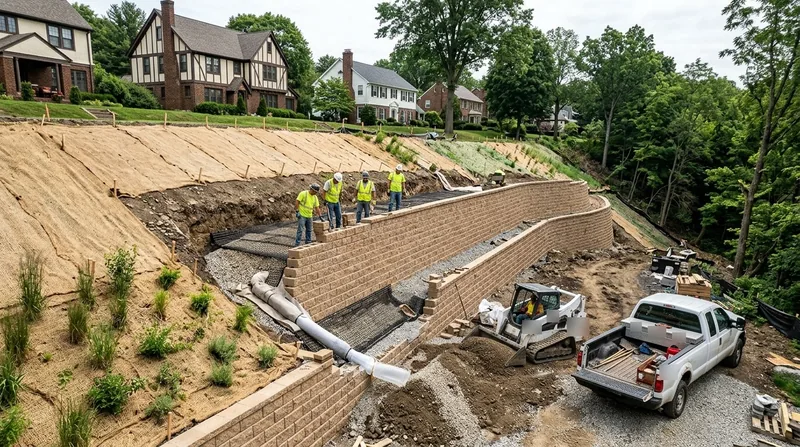




Cleveland sits on a flat lake plain cut by steep ravines along the Cuyahoga, Rocky River, Big Creek and Doan Brook, and those slopes are where erosion does its quiet damage. Homes on the Lake Erie bluffs in Lakewood and Bay Village, hillside lots in Cleveland Heights and Shaker Heights, and cut-and-fill yards through Parma and Mentor all sit on dense glacial clay and till that holds water and moves under freeze-thaw. Slope Stabilization & Erosion Control in Cleveland means holding that ground in place with terraced walls, geogrid reinforcement and drainage before a ravine edge creeps toward a foundation or driveway. We build the structural fix, not a cosmetic patch. If the slope is already failing, start with leaning and collapsed wall repair.
Why Slope Stabilization & Erosion Control Matters on Cleveland's Ravine and Bluff Lots
Most of Cleveland's residential damage comes from water pressure inside clay, not from the wall itself. Glacial till drains slowly, the water table sits high in spring, and freeze-thaw cycles push saturated soil outward every winter. On the bluffs, lake-effect snowmelt and wave-driven undercutting at the toe compound the problem. A bare or underbuilt slope will slough, and a slumping ravine edge will take a driveway, patio or foundation wall with it.
- Slopes along Doan Brook and the Rocky River ravine lose topsoil and undercut existing walls from below.
- Lakefront yards in Bay Village and Lakewood face bluff erosion driven by storm runoff and toe saturation.
- Hillside lots in Cleveland Heights and Shaker Heights fail where downspouts and surface water concentrate on one line.
- Cut-and-fill lots in Parma and Strongsville settle and crack where the fill was never compacted or drained.
Treating the water and reinforcing the slope is what stops the cycle, and that is the work we do.
Key info: A Tremont or Ohio City lot with a narrow side yard and a 6-foot grade change needs a different fix than a wooded Shaker Heights ravine lot with 15 feet of drop. We size the reinforcement and drainage to the actual slope, not to a template.
For permit thresholds and engineered-drawing requirements on walls that retain a surcharge, verify current rules with the City of Cleveland building department before work starts.
How We Stabilize a Failing Slope in Cleveland
We start by reading the water. We walk the slope, find where runoff enters and exits, check the existing wall and footing, and look for tension cracks, bulging and toe erosion. Then we build a fix that handles both the soil and the drainage, because reinforcement without drainage just delays the failure.
- We map the slope, soil and water path, including downspouts, sump discharges and uphill runoff sources.
- We cut back and bench the slope into terraces so each wall retains a smaller, stable height.
- We install geogrid reinforcement in lifts behind segmental block or boulder walls to tie the face into the retained soil.
- We set a gravel drainage chimney and perforated footing drain to relieve hydrostatic pressure behind the wall.
- We surface the slope with erosion control matting, riprap or planted cover to stop raindrop and sheet erosion.
- We restore the yard, re-grade the surface to shed water away from the slope, and walk you through what to watch.
Each step gets documented so you can see what was built and why.
Local example: On a Lakewood bluff lot, we terraced a 12-foot drop into two segmental block walls with geogrid and a gravel drainage chimney, then armoured the toe with riprap to take storm runoff off the bluff face.
Where the slope meets a driveway or structure, the work ties into our retaining wall drainage scope so the whole system drains as one.
Slope Stabilization Methods We Use in Cleveland
No single approach fits every slope. We choose based on height, soil, water, access and what the slope is protecting. The table below shows where each method fits.
| Approach | Description | Best for |
|---|---|---|
| Terraced segmental block walls | Step the slope into two or more shorter walls with geogrid and drainage. | Ravine and hillside lots with 6 to 15 feet of drop |
| Geogrid reinforced soil | Grid layers tie the wall face into the retained soil mass. | Tall walls and slopes carrying a driveway or structure |
| Boulder and riprap toe protection | Heavy stone armours the toe against runoff and undercutting. | Bluff and ravine toes with active erosion |
| Drainage chimney and footing drain | Gravel and perforated pipe relieve water pressure behind the wall. | Clay soils and high water table sites |
| Erosion control matting and planting | Mats and deep-rooted cover hold surface soil between walls. | Bare slopes and finished terraces |
We combine these methods on most jobs, because a slope that moves is almost always losing water somewhere.
Slope Stabilization & Erosion Control Cost in Cleveland: What to Expect
Every estimate starts with a free on-site look, because the number depends on slope height, soil, water and access. A small terraced garden slope in Parma costs far less than a bluff toe repair in Bay Village. The factors that move the price most are total wall height, how much geogrid is needed, drainage scope, and whether equipment can reach the slope.
- Slope height and number of terraces drive the wall square footage and reinforcement volume.
- Soil and water conditions decide how much drainage and excavation the job needs.
- Access limits whether we can use a machine or must dig and carry by hand.
- Proximity to foundations, driveways and property lines adds care and sometimes engineering.
- Surface protection (matting, riprap, planting) adds a finishing cost that prevents repeat erosion.
Get two or three estimates and compare scope, not just the bottom line. Our full pricing overview shows how the numbers break down.
Slope Stabilization & Erosion Control Near Me: Hiring a Contractor Near Cleveland
Hiring for slope work is different from hiring for a flat-lot wall, because the consequences of a bad build show up within a season or two. Ask direct questions and check the answers. A contractor who cannot explain drainage and reinforcement in plain terms is not the right fit for a ravine or bluff lot.
- Confirm the contractor is fully insured, and ask for a certificate before work starts.
- Get at least two or three written estimates with scope, materials and drainage details spelled out.
- Ask for references from jobs on similar slopes, ideally in Cleveland Heights, Lakewood or Mentor.
- Check permit requirements with the local building department, especially for walls over roughly 4 feet or walls supporting a surcharge.
- Ask how they handle property-line setbacks and any HOA or historic-district rules on your street.
Good slope work is boring to look at and quiet for decades, and that is the standard to hire against. Reach us through our contact page to set up a free estimate.
Slope Stabilization & Erosion Control in Cleveland: Pricing Guide
| Service | Price | Details |
|---|---|---|
| On-site slope assessment | Free estimate | Includes a walk of the slope, water-path check and a written scope with recommended methods. |
| Small terraced garden slope | Starting at $3,500 | Covers one short segmental block terrace with drainage; height and access move the price. |
| Ravine or hillside stabilization | Starting at $12,000 | Multiple terraces, geogrid and drainage; total wall height and soil conditions drive the number. |
| Bluff toe and large-scale repair | On estimate | Needs an on-site look for access, toe protection and engineering before any figure is given. |
| Travel | Included | in Cleveland and surrounding areas, no separate call-out or mileage fee |
| Estimate | Free | Response within 24h at (216) 640-7629, no obligation to book |
Indicative pricing, the exact cost depends on square footage, finish, and site access. Free personalized estimate within 24h at (216) 640-7629.


