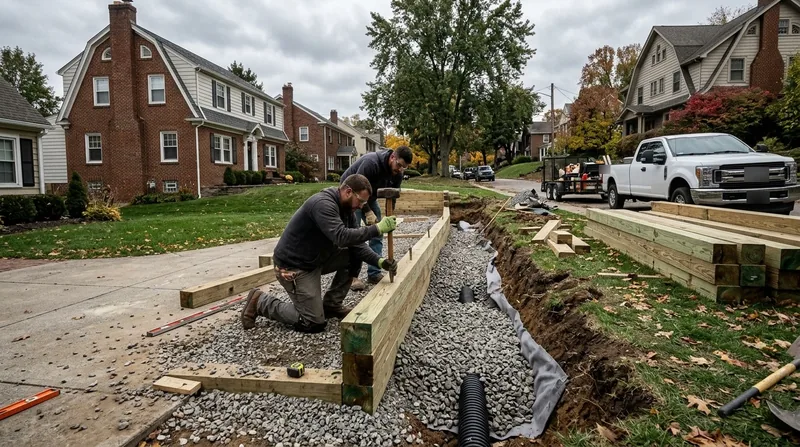




Timber Retaining Walls in Cleveland are the budget-friendly workhorse for garden beds and low terraces, and we build them the right way for this city's ground. Cleveland sits on a flat lake plain cut by steep ravines along the Cuyahoga, Rocky River, Big Creek and Doan Brook, so a yard here drains fast on one side and holds water on the other. In Tremont and Ohio City, narrow lots behind 1900s frame doubles leave little room to work. In Cleveland Heights and Shaker Heights, wooded rolling lots push water against every wall. And along the Lake Erie bluffs in Lakewood and Bay Village, dense glacial clay and a high water table never let a wall rest easy. Timber makes sense for low garden walls and raised beds. It does not make sense for a wall holding up a driveway or a structure, and we tell you that straight. Start with our retaining wall installation service to see how a timber wall fits your project.
Why Timber Walls Fail Fast in Cleveland's Clay and Freeze-Thaw Cycles
Our freeze-thaw cycle is the real enemy of a timber wall. Water soaks into dense glacial till, freezes overnight, and pushes the wall out of line. Lake-effect snow keeps the ground saturated into March. Then a warm afternoon softens the clay and the wall creeps forward an inch at a time. On the ravines off Big Creek and Doan Brook, the slope adds gravity to the problem. A timber wall built without proper drainage fails in three to five years here, not fifteen.
- Pressure-treated 4x4 or 6x6 timbers rot from the back face where you cannot see the damage.
- Clay soil holds water against the wood and speeds decay at the base course.
- Freeze-thaw movement opens the joints between courses and lets roots and water in.
- Old railroad tie walls from the 1970s are already at the end of their life across Parma and Strongsville.
We inspect the soil, the slope and the drainage before we quote a timber wall, because the ground decides whether timber is honest or a short-term patch.
Key info: A timber wall in Cleveland Heights that holds a garden bed at 2 feet high can last 12 to 15 years with a gravel drainage layer behind it. The same wall without drainage leans within 4 winters. We have replaced both kinds on the same street.
For the local permit thresholds on walls above roughly 4 feet, or walls that carry a surcharge like a driveway, check with the City of Cleveland Department of Building and Housing at clevelandohio.gov before you build. Thresholds vary by suburb and must be verified.
How We Build a Timber Wall That Survives Cleveland Winters
We build timber walls in a sequence that starts underground, not above it. The footing and drainage matter more than the wood itself. We dig to frost depth, set a compacted gravel base, and slope the ground behind the wall so water runs away from the wood. Then we set the timbers with proper overlap and deadmen where the wall needs them. Every wall we build gets a drainage layer and an outlet, because a timber wall that traps water is a wall on a countdown.
- We walk the site and check the slope, the soil and where water goes during a spring thaw.
- We dig a trench to the footing depth your local building department requires.
- We compact a gravel base and set the first course level, which sets the whole wall.
- We install a gravel drainage layer and filter fabric behind the timbers as we stack.
- We tie the courses with deadmen or geogrid where the wall height or the slope calls for it.
- We backfill in lifts and compact each lift so the wall does not settle.
- We cut and cap the top course and clean the site.
For a Lakewood lot near the bluffs, we once found a 3-foot timber bed wall that had no drainage at all. Water from the yard above had been running into the wood for a decade. We rebuilt it with a gravel core and an outlet to the grade, and it has held through four winters since.
Key info: In Parma and Strongsville, most timber walls we see were built against the house grade with no outlet. We route the drain to daylight or a dry well so the wall does not become a dam. See our retaining wall drainage service for how we handle water on tight lots.
Timber Wall Approaches We Use Across Cleveland
Not every timber wall is the same build. The height, the soil and what the wall holds decide the method. We match the approach to the site instead of forcing one system onto every yard. Here is how the options compare for Cleveland conditions.
| Approach | Description | Best for |
|---|---|---|
| Stacked timber bed wall | Pressure-treated 4x4 or 6x6 courses on a gravel base with a drainage layer behind. | Garden beds and low terraces up to 2 feet in Tremont and Ohio City. |
| Deadman-anchored timber wall | Timbers tied back into the slope with deadmen or geogrid to resist clay pressure. | Walls 2 to 4 feet high on sloped lots in Cleveland Heights and Shaker Heights. |
| Terraced timber system | Two or more stepped walls with drainage between each tier. | Yards with grade change along the Rocky River and Big Creek ravines. |
| Timber-to-block upgrade | Replace failed timber with segmental block where the wall must last decades. | Driveway walls and structural walls in Parma, Mentor and Strongsville. |
If your wall holds anything heavier than soil and plants, we will tell you to move up to block or concrete, because timber is not the right material for a structural load in this climate.
Timber Retaining Walls Cost in Cleveland: What to Expect
Timber retaining walls in Cleveland start at From $20 per square foot for a basic stacked bed wall with drainage. That figure covers labor, pressure-treated timbers, gravel, filter fabric and cleanup. A wall that needs deadmen, geogrid or a terraced build runs higher. So does a tight lot in Lakewood or Cleveland Heights where we hand-carry material through a side gate. Access and wall height move the number more than the wood itself.
We quote after we see the slope, the soil and the drainage path. A wall that looks simple on a flat Parma lot can need a different footing than one on a ravine lot in Bay Village. Get two or three estimates and compare what is included, especially drainage. A cheap quote that skips the gravel layer is not cheaper in five years. Our full pricing overview breaks down what each line item covers.
Timber Retaining Walls Near Me: How to Hire a Contractor Near Cleveland
Hiring for a timber wall near Cleveland comes down to a few checks that separate a real contractor from a guy with a truck. Ask for proof of insurance before work starts, not after. Ask how they handle drainage, because the answer tells you whether the wall will last. And ask whether they pull permits when your city requires one. A contractor who dodges those questions is a risk on a wall that holds soil against your house.
- Confirm the contractor is fully insured, and ask for a certificate of insurance.
- Get two or three written estimates that list materials, drainage and cleanup.
- Ask for references from jobs in your suburb and call at least one.
- Check with your local building department on permit thresholds for walls over roughly 4 feet.
- Ask how they protect existing trees and landscaping on wooded lots.
Reach us through our contact page or call (216) 640-7629 to set up a free estimate.
Timber Retaining Walls in Cleveland: Pricing Guide
| Service | Price | Details |
|---|---|---|
| Stacked timber bed wall | Starting at $20/sq ft | Includes pressure-treated timbers, gravel base, drainage layer and cleanup for low garden walls. |
| Deadman-anchored timber wall | Starting at $28/sq ft | Adds deadmen or geogrid tie-backs for walls 2 to 4 feet high on sloped lots. |
| Terraced timber system | Starting at $35/sq ft | Stepped walls with drainage between tiers for yards with significant grade change. |
| Timber-to-block upgrade | On estimate | Failed timber replaced with segmental block; scope needs an on-site look before pricing. |
| Travel | Included | In Cleveland and surrounding areas, no separate call-out or mileage fee. |
| Estimate | Free | Response within 24h at (216) 640-7629, no obligation to book. |
Indicative pricing, the exact cost depends on square footage, finish, and site access. Free personalized estimate within 24h at (216) 640-7629.


