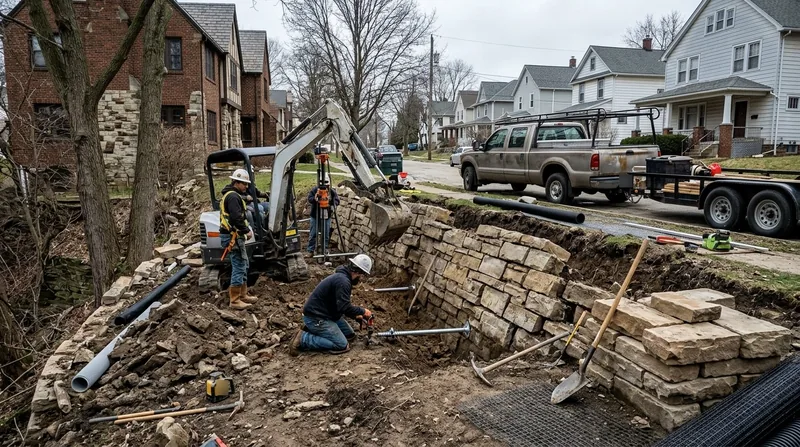




If you own a home in Cleveland, you already know the ground here moves. Dense glacial clay and till, a high water table, and relentless freeze-thaw cycles push walls out of line season after season. From the old Berea sandstone block walls in Tremont to the poured concrete driveway walls in Parma and the rotting 1970s railroad tie terraces in Mentor, Retaining Wall Repair in Cleveland is not a cosmetic job. It is a structural rescue. We repair leaning, bowing, cracked, and heaving walls before they become a collapse. Call (216) 640-7629 for a free estimate. Learn more about leaning and collapsed wall repair.
Why Retaining Wall Repair Matters in Cleveland's Clay and Freeze-Thaw Cycle
Cleveland sits on a flat lake plain cut by steep ravines along the Cuyahoga, Rocky River, Big Creek, and Doan Brook. That terrain puts pressure on every wall holding back a slope. The real killer is water. Glacial clay traps moisture, and when it freezes, it expands with enough force to crack CMU, shove segmental block out of alignment, and snap timber posts. Lake-effect snow adds meltwater every spring.
Most failures we see follow the same pattern:
- Poor drainage lets hydrostatic pressure build behind the wall until it bulges or leans.
- Clogged weep holes and failed backfill keep water trapped, so the wall never gets relief.
- Freeze-thaw movement opens cracks in concrete and mortar joints that widen every winter.
- Root pressure from mature trees pushes walls out of line on wooded lots in Cleveland Heights and Shaker Heights.
- Rotted timber and railroad ties lose their structural capacity after 20 to 30 years of wet cycles.
The earlier you address these signs, the cheaper the fix. A leaning wall caught in year one is a drainage and anchor job. Caught in year five, it is a partial rebuild.
Key info: A wall along the Lake Erie bluffs in Bay Village or Lakewood faces the same clay and frost as one in Parma, but the slope adds surcharge pressure. We check both drainage and global stability before quoting any repair.
How We Diagnose and Repair Retaining Walls in Cleveland
We do not guess. Every repair starts with a site inspection that looks at the wall face, the soil behind it, the footing, and how water moves through the yard. On older properties in Ohio City and Slavic Village, we also check for buried utilities and original sandstone footings that may be undermining the wall. Then we match the fix to the failure mode.
- We walk the wall and mark every crack, lean, and bulge, then measure the movement against the footing.
- We dig test pits behind the wall to see what the backfill and drainage look like.
- We check for water sources: downspouts, grade, sump discharge, and spring thaw paths.
- We recommend the least invasive repair that restores structural capacity, from drainage correction to tieback anchors to a partial rebuild.
- We pull permits when the local building department requires them for walls above roughly 4 feet from the footing.
Every repair ends with a drainage plan, because a wall that stays wet will fail again.
Key info: A 1920s sandstone wall in Tremont was leaning 3 inches after decades of blocked weep holes. We reset the top courses, installed a proper drain gravel and perforated pipe system, and tied the wall back with anchors. No full rebuild was needed. See how we handle retaining wall drainage.
Repair Methods We Use on Cleveland Walls
Not every wall needs the same fix. We choose the method based on wall type, height, soil, and how far it has moved. Here is how the main approaches compare.
| Approach | Description | Best for |
|---|---|---|
| Drainage correction | We clear weep holes, install perforated pipe and gravel, and regrade the soil behind the wall to relieve hydrostatic pressure. | Walls that are damp, staining, or showing early lean with no structural cracking. |
| Tieback anchors | We drive helical or grouted anchors through the wall into stable soil and connect them to a face plate to pull the wall back to plumb. | Leaning or bowing walls where the footing is still sound and the wall can be straightened. |
| Partial rebuild | We remove and rebuild the failed section, matching the existing block or concrete, and correct the base and drainage at the same time. | Cracked or heaved sections where the rest of the wall is still stable. |
| Crack injection and mortar repair | We inject structural epoxy or polyurethane into cracks and repoint mortar joints to restore water tightness and strength. | Poured concrete and CMU walls with isolated cracks but no major movement. |
| Timber and tie replacement | We replace rotted timbers and railroad ties with new pressure-treated timber or switch to segmental block where the wall needs a longer service life. | 1970s and 1980s timber walls that are sagging, rotting, or losing height. |
We match the repair to the wall, not the other way around. If a wall is too far gone, we tell you that a retaining wall replacement is the better investment.
Retaining Wall Repair Cost in Cleveland: What to Expect
Most retaining wall repairs in Cleveland start around From $1,500 for drainage correction and localized crack repair. Tieback anchoring and partial rebuilds run higher because they involve excavation, anchors, and new materials. The final number depends on wall length, height, access, and how much soil has to be moved. A wall in a tight Tremont side yard costs more to access than a wall along a wide driveway in Strongsville.
Factors that move the price:
- Wall height and length determine how much material and labor the job requires.
- Access for equipment and spoil removal raises cost on narrow lots and steep ravine lots.
- Wall material affects repair method: concrete and CMU need different techniques than segmental block or timber.
- Proximity to structures such as driveways, garages, and foundations adds engineering and protection requirements.
- Urgency matters if the wall is close to collapse and needs temporary shoring.
We recommend getting two or three estimates on any repair over $2,000. It is the best way to compare scope, not just price. See our full pricing overview for more detail.
What to Look For When Hiring a Retaining Wall Contractor Near Me in Cleveland
Hiring the right contractor matters more on retaining walls than on most home projects, because a bad repair can hide a failure that gets worse. Start with fully insured status, and ask for a certificate of insurance before work begins. Get at least two written estimates that describe the repair method and drainage plan, not just a number. Ask for references from jobs in Cleveland and surrounding suburbs, and check whether the contractor has worked on your wall type before.
Permits matter too. Many Cleveland-area jurisdictions require a permit for walls above roughly 4 feet from the footing, or when the wall supports a driveway or structure. Always verify with your local building department, because thresholds vary. If your property is in a historic district or has an HOA, check those rules before approving a repair method. We are happy to walk you through the permit question. Contact us for a free estimate and we will tell you what your wall needs and what the city will require.
Retaining Wall Repair Near Me: What Cleveland Homeowners Should Know
If you are searching for retaining wall repair near me in Cleveland, the first question is usually whether the wall can be saved. In most cases it can, if the failure is caught early. A wall that leans 1 to 2 inches is a drainage and anchor job. A wall that has lost height, cracked through the footing, or dumped soil into the yard is a rebuild candidate. We give you a straight answer on which one you are facing, and we do not sell a rebuild when a repair will hold.
We work across Cleveland and the surrounding suburbs, including Lakewood, Parma, Cleveland Heights, Shaker Heights, Mentor, Strongsville, Westlake, and Bay Village. Call (216) 640-7629 to schedule an inspection. We respond within 24 hours and the estimate is free.
Key info: A 1970s railroad tie wall in Mentor was sagging 8 inches and dumping soil onto the driveway. We replaced the failed section with segmental block and corrected the drainage. The homeowner avoided a full replacement and a collapsed driveway. See our railroad tie wall replacement service for more.
Do not wait for the spring thaw to find out your wall moved. We inspect, repair, and stabilize retaining walls across Cleveland. Fully insured. Free estimates. Call (216) 640-7629.
Retaining Wall Repair in Cleveland: Pricing Guide
| Service | Price | Details |
|---|---|---|
| Drainage correction and crack repair | Starting at $1,500 | Includes weep hole clearing, drain gravel and pipe, crack injection, and regrading behind the wall. |
| Tieback anchor installation | Starting at $3,500 | Includes helical or grouted anchors, face plates, and pulling the wall back to plumb. |
| Partial rebuild of failed section | Starting at $4,500 | Includes demolition, new base, drainage, and matching block or concrete for the failed section. |
| Timber and railroad tie replacement | Starting at $3,000 | Includes removal of rotted timbers, new pressure-treated timber or block, and drainage correction. |
| Complex or large-scale repair | On estimate | Tall walls, ravine lots, and walls supporting driveways need an on-site look before pricing. |
| Travel | Included | In Cleveland and surrounding areas, no separate call-out or mileage fee. |
| Estimate | Free | Response within 24h at (216) 640-7629, no obligation to book. |
Indicative pricing, the exact cost depends on square footage, finish, and site access. Free personalized estimate within 24h at (216) 640-7629.


