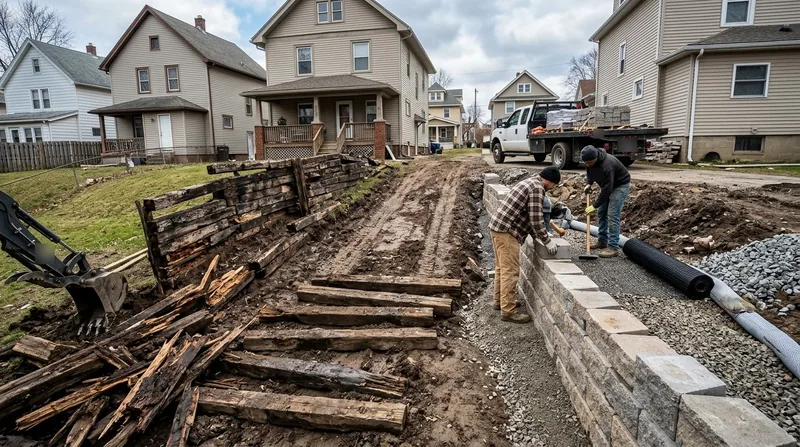




Railroad Tie Wall Replacement in Cleveland
Cleveland's older neighborhoods are full of retaining walls built from creosote-soaked railroad ties in the 1970s and 1980s. Those ties are now at the end of their service life, and in a city built on dense glacial clay with a high water table, they rot fast and push out of line. Railroad Tie Wall Replacement in Cleveland means tearing out the old timber, hauling away the creosote-treated wood, and rebuilding the wall in segmental block, poured concrete, or natural stone with proper gravel backfill and drainage. We handle the whole job, from demolition to the final compacted lift of backfill. If your tie wall is leaning or collapsing, start with our leaning and collapsed wall repair page before the failure spreads.
Why Cleveland Railroad Tie Walls Are Failing Now
Most of the tie walls we replace were built before 1990, and creosote only slows decay for so long. In Cleveland Heights and Shaker Heights, where rolling wooded lots drain into Doan Brook, the soil stays wet and the ties rot from the back face first. On the lake plain through Parma and Strongsville, freeze-thaw cycles push walls out of line every winter. The failure mode that dominates here is rot plus frost heave, not coastal erosion or salt spray.
- Ties rot at the soil line and lose their structural section, so the wall starts to bulge.
- Clay till traps water behind the wall, and the hydrostatic pressure pushes it forward.
- Freeze-thaw cycles open joints and shift the wall out of plumb each season.
- Creosote leaches into planting beds and is hard to remove once it is in the soil.
Once a tie wall starts to lean, patching it rarely buys more than a season or two, and replacement is the practical fix.
Key info: A typical 1970s tie wall along a Slavic Village or Ohio City side lot is 3 to 4 feet tall and 30 to 40 feet long. When we open it up, we usually find no gravel behind the ties and a clay backfill that holds water like a bathtub.
For local permit thresholds and setback rules, check with the City of Cleveland Building and Housing Department before any wall is rebuilt: clevelandohio.gov. Many jurisdictions require a permit above roughly 4 feet measured from the footing, or when the wall supports a driveway or structure.
How We Replace a Railroad Tie Wall in Cleveland
We treat every tie wall replacement as a drainage job first and a wall job second. The old ties come out, we expose the footing and the soil behind the wall, and we rebuild with free-draining gravel and a perforated drain pipe at the base. That is what keeps the new wall from repeating the failure the old one had.
- We mark utilities and the property line, then cut back the slope and remove plantings that block access.
- We excavate to the footing, compact the subgrade, and set a level gravel base.
- We install a perforated drain pipe and washed gravel backfill wrapped in filter fabric.
- We build the new wall in segmental block, poured concrete, or natural stone, set with the proper batter.
- We compact the backfill in lifts and finish the grading so water drains away from the wall.
The result is a wall that sheds water instead of holding it, and it will not rot.
Key info: On a recent job in Cleveland Heights, a 1970s tie wall was holding back a terraced garden above a Doan Brook ravine lot. We replaced it with a segmental block wall on a gravel base, added drainage, and tied the new wall into the slope above so the terrace stayed usable. See our slope stabilization and erosion control work for similar ravine lots.
Replacement Approaches We Use
Not every tie wall should be rebuilt the same way. The right choice depends on height, the load behind the wall, access for equipment, and how the wall fits the house and lot. We walk the site and recommend the option that matches the load and the budget.
| Approach | Description | Best for |
|---|---|---|
| Segmental block replacement | Interlocking block units on a gravel base with drain pipe and gravel backfill. | Garden terraces and side-lot walls in Tremont and Ohio City. |
| Poured concrete replacement | Reinforced concrete wall formed and poured on site, with drainage behind it. | Driveway walls and walls carrying a surcharge in Parma. |
| Natural stone replacement | Boulder or stacked stone wall built to match the older Berea sandstone walls nearby. | Lakefront and ravine lots in Lakewood and Bay Village. |
| Timber replacement | New pressure-treated timber built with proper drainage and batter. | Low garden walls where budget matters more than lifespan. |
| Tiered replacement | Two or more shorter walls stepped back into the slope instead of one tall wall. | Steep ravine lots where a single tall wall would need engineering. |
For block and stone options, see our block and segmental retaining walls page.
Railroad Tie Wall Replacement Cost in Cleveland: What to Expect
Most replacements start around $35 per square foot of wall face, and that figure moves with height, access, and what is behind the old wall. A low garden wall on a flat lot in Parma sits near the bottom of the range. A tall wall on a ravine lot in Cleveland Heights with limited equipment access sits well above it. Demolition and disposal of creosote-treated ties add cost on every job, because the wood cannot go in a standard dumpster.
Get two or three written estimates and compare the scope, not just the number. A cheap bid that skips the drain pipe or the gravel backfill will cost more in five years. Our full pricing overview breaks down what each line item covers.
Choosing a Retaining Wall Contractor Near Me in Cleveland
Retaining wall work is not hard to sell and it is easy to do wrong. The contractor you hire should be able to explain the drainage detail, show you a wall they built five years ago, and tell you whether your project needs a permit. If they cannot answer those three questions, keep calling.
- Confirm the company is fully insured, and ask for a certificate of insurance before work starts.
- Get at least two or three written estimates that list demolition, disposal, drainage, and backfill separately.
- Ask for references on walls at least three or four winters old, since freeze-thaw is what tests a wall here.
- Ask who pulls the permit, and verify the local threshold with your building department.
- Check HOA rules and property-line setbacks before the design is final.
When you are ready to talk through your wall, reach us through the contact page or call (216) 640-7629.
When to Call for a Railroad Tie Wall Replacement
Late winter and early spring are when most tie walls in Cleveland announce themselves. The ground heaves, the ties shift, and a wall that looked fine in November is leaning by March. That is also when our call volume peaks, so booking an assessment in late fall or early winter gets you on the schedule before the thaw. If a wall is already bulging or the soil behind it is sliding, do not wait for spring: call (216) 640-7629 and we will take a look.
Railroad Tie Wall Replacement in Cleveland: Pricing Guide
| Service | Price | Details |
|---|---|---|
| Segmental block replacement | Starting at $35/sq ft | Includes tie demolition, haul-away, gravel base, drain pipe and block installation; height and access move the price. |
| Poured concrete replacement | Starting at $45/sq ft | Includes forming, rebar, pour and drainage behind the wall; surcharge loads and tight access raise the rate. |
| Natural stone replacement | Starting at $55/sq ft | Includes boulder or stacked stone set on a gravel base with drainage; stone type and haul distance affect cost. |
| Timber replacement | Starting at $30/sq ft | Includes new pressure-treated timber, gravel backfill and drain pipe; low garden walls only, not structural walls. |
| Complex or large-scale job | On estimate | Tiered walls, ravine lots and walls over 4 feet need an on-site look and possibly engineered drawings before pricing. |
| Estimate | Free | Response within 24 hours at (216) 640-7629, no obligation to book the work. |
Indicative pricing, the exact cost depends on square footage, finish, and site access. Free personalized estimate within 24h at (216) 640-7629.


