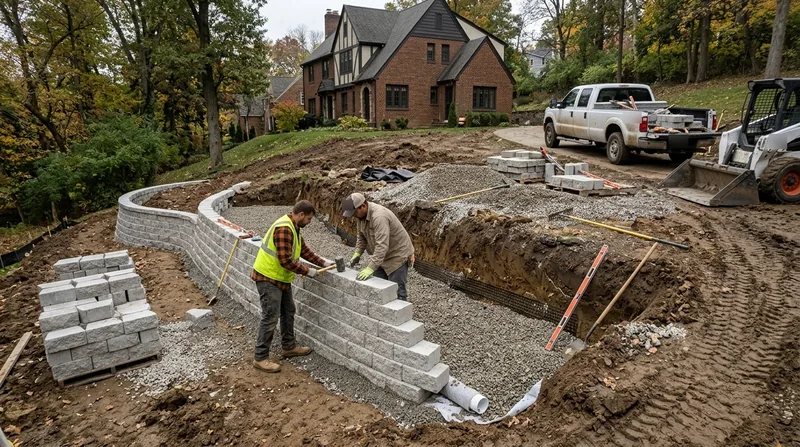




Cleveland sits on a flat lake plain cut by steep ravines along the Cuyahoga, Rocky River, Big Creek and Doan Brook, so retaining walls here do real structural work, not just decoration. In Tremont, Ohio City and Slavic Village, narrow lots behind workers' cottages and frame doubles often hold block & segmental retaining walls in Cleveland that have been pushed out of line by dense glacial clay and a high water table. Out in Cleveland Heights and Shaker Heights, Tudor and Colonial Revival homes sit on rolling wooded lots where tiered walls hold terraces above the grade change. Along the Lake Erie bluffs in Lakewood and Bay Village, walls fight slope movement and relentless freeze-thaw cycles under grey lake-effect skies. We build mortarless engineered block walls with geogrid reinforcement that stay plumb and drain properly in this soil. Start with our retaining wall installation service, or call (216) 640-7629 for a free estimate.
Why Segmental Block Walls Make Sense on Cleveland's Clay and Ravines
Cleveland's glacial till holds water and swells, then drops hard during freeze-thaw, and that cycle is what pushes old poured concrete and CMU driveway walls out of line every spring. Segmental block systems handle that movement better than rigid walls because each course flexes slightly and geogrid ties the wall back into the slope. Most of the failures we see in Parma, Strongsville and Mentor trace back to missing drainage, not bad block.
- We set every wall on a compacted granular base so it does not settle into soft clay.
- We install geogrid every two to three courses on walls over four feet to resist overturning.
- We backfill with free-draining gravel and pipe the water out, which is the single biggest fix for Cleveland walls.
- We cap the wall and grade the soil behind it so runoff moves away from the block face.
That drainage-first approach is why our block walls hold up through lake-effect snow and the spring thaw.
Key info: A 1970s railroad tie wall in Westlake we replaced last spring had no gravel behind it at all. The ties were rotted through and the clay had pushed the face out 14 inches. The Allan Block replacement with geogrid and a drainage chimney has not moved a fraction since.
For official guidance on wall permits and footing requirements, check the City of Cleveland's building and housing department before you build: City of Cleveland Building & Housing.
How We Build a Segmental Retaining Wall in Cleveland
We start with a site walk and a string line, because the grade change and the soil tell us more than any drawing. Then we excavate to the footing depth the wall height calls for and compact the base in lifts. On a ravine lot in Cleveland Heights, that often means shoring the uphill side before we touch the slope.
- We mark the wall line, check setbacks and call for utility locates before any digging.
- We excavate and compact a level granular base, deeper on taller walls.
- We set the first course dead level, because every course above it inherits that line.
- We place geogrid and compact backfill in lifts as the wall rises.
- We install the drainage gravel, perforated pipe and filter fabric behind the block.
- We cap the wall, backfill and regrade the slope so water runs away from the face.
Every wall gets checked for plumb and line before we leave the site.
Key info: On a Lakewood lot near the bluff, the homeowner wanted a two-tier Versa-Lok terrace for a garden. We set the lower wall back into the slope, tied both tiers with geogrid and tied the drainage into a French drain at the toe. It handles the spring melt without a puddle on the patio.
If water is already pooling behind an existing wall, our retaining wall drainage service addresses that before the block moves.
Block Wall Approaches We Use in Cleveland
Not every wall needs the same system. The block, the reinforcement and the batter change with height, soil and what the wall is holding back. Here is how we match the approach to the job.
| Approach | Description | Best for |
|---|---|---|
| Allan Block garden wall | Mortarless block up to about three feet with a gravel core and no geogrid. | Planting terraces and low garden walls on flat lots. |
| Versa-Lok tiered terrace | Pinned block with geogrid every two courses, set back in tiers. | Cleveland Heights and Shaker Heights slope lots with grade change. |
| Keystone structural wall | Engineered block with grid layers designed to the wall height and surcharge. | Driveway and structure walls over four feet. |
| Ravine toe wall | Battered block wall with a deep drainage chimney and toe protection. | Cuyahoga and Rocky River ravine properties with slope movement. |
| Curved block wall | Segmental units laid on a sweeping radius with no cutting needed. | Driveway entrances and curved garden borders. |
We pick the system after we see the soil and the height, not before.
Block & Segmental Retaining Walls Cost in Cleveland: What to Expect
Most segmental block walls in Cleveland start around $25 per square foot of wall face, and that figure climbs with height, access and how much soil the wall has to hold. A low garden wall on a flat Parma lot sits near that floor. A four-foot wall with geogrid on a tight Cleveland Heights lot, where a machine cannot reach the back, runs higher because every block gets carried by hand.
Wall height is the biggest driver. Anything over four feet usually needs engineered design, more geogrid and a deeper base. Access matters just as much: a backyard wall behind a narrow Slavic Village lot costs more than the same wall beside a driveway in Strongsville. Drainage work, tear-out of an old failed wall and permit fees all add to the number.
Get two or three written estimates on the same wall line and compare what each one includes. A low bid that skips geogrid or drainage gravel is not a lower price, it is a shorter-lived wall. Our pricing overview lays out the full range.
Block & Segmental Retaining Walls Near Me: Hiring a Contractor Near Cleveland
Ask for proof of licensing and insurance before anyone walks your slope, and get the certificate sent to you, not just a verbal yes. Ask for references on walls at least three years old, because that is when drainage mistakes start to show. Confirm who pulls the permit: in most Cleveland-area jurisdictions a wall over roughly four feet, or one holding a driveway or structure, needs one, and the local building department sets the threshold.
Ask how the contractor handles drainage, and walk away from anyone who says gravel behind the wall is optional. Check HOA rules before you pick a block color or a wall line, especially in the planned subdivisions around Mentor and Strongsville. When you are ready, contact us for a free estimate and we will walk the site with you.
Block & Segmental Retaining Walls in Cleveland: Pricing Guide
| Service | Price | Details |
|---|---|---|
| Garden wall (under 3 ft) | Starting at $25/sq ft | Allan Block or Versa-Lok with gravel core and drainage, no geogrid required at this height |
| Structural wall (4 ft and up) | Starting at $38/sq ft | Includes geogrid layers, engineered design and deeper base, price rises with height |
| Tiered or terraced wall | Starting at $45/sq ft | Multiple setback tiers with tied geogrid and drainage between each level |
| Failed wall tear-out and rebuild | On estimate | Old railroad tie or concrete removal, soil correction and haul-away need an on-site look |
| Travel | Included | In Cleveland and surrounding areas, no separate call-out or mileage fee |
| Estimate | Free | Response within 24h at (216) 640-7629, no obligation to book |
Indicative pricing, the exact cost depends on square footage, finish, and site access. Free personalized estimate within 24h at (216) 640-7629.


