Why Northeast Ohio's Soil and Winters Demand the Right Materials
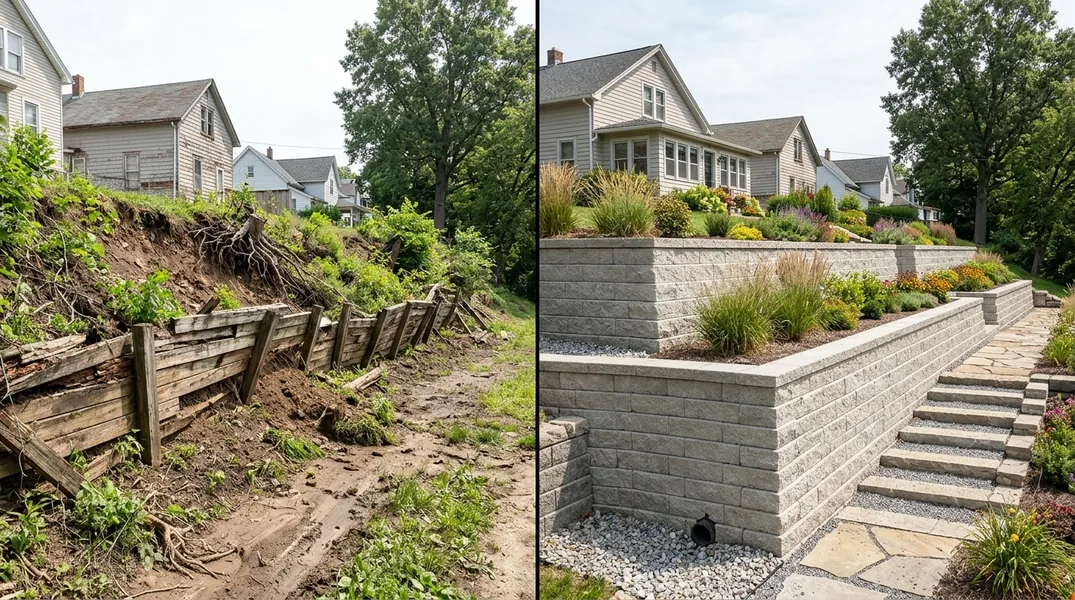
If you live in Cleveland, you already know that our weather is not gentle on outdoor structures. The combination of heavy clay soil and repeated freeze-thaw cycles puts extraordinary stress on retaining walls. Clay expands when it absorbs water and contracts as it dries, pushing against your wall with tremendous force. Then winter arrives, and moisture trapped in the soil freezes, expands, and shifts everything it touches. A wall that looks fine in July can develop cracks and bulges by February.
Choosing the right material is not just about aesthetics. It is about structural survival. A retaining wall must handle lateral earth pressure, hydrostatic pressure from trapped water, and the physical movement caused by frost heave. Some materials handle these forces far better than others. In this article, we break down the best options for Northeast Ohio: Concrete Retaining Walls, block retaining walls, boulder retaining walls, and segmental retaining walls. We will explain how each performs in our local conditions so you can make an informed decision.
Concrete Retaining Walls: The Heavyweight Champion for Clay Soil
When it comes to resisting the relentless pressure of clay soil, poured concrete is hard to beat. A properly engineered concrete wall is massive, rigid, and capable of holding back significant loads without flexing. In Cleveland, where clay content in the soil is high, this rigidity is a major advantage. Concrete walls can be designed with footings that extend below the frost line, which is critical for preventing frost heave from lifting or tilting the wall.
That said, concrete is not maintenance-free. It can crack over time, especially if water management is poor. We always recommend integrating proper drainage, like weep holes and gravel backfill, to relieve hydrostatic pressure. For homeowners who want a permanent, low-maintenance solution and are willing to invest in professional Retaining Wall Installation, concrete is an excellent choice. It also offers a clean, modern look that can be textured or stained to match your home's exterior.
Block and Segmental Retaining Walls: Flexibility Meets Durability
Block retaining walls, often called segmental retaining walls, are made from interlocking concrete blocks. These systems are engineered to flex slightly with soil movement, which is a huge benefit in clay-rich areas. Instead of cracking like a rigid concrete wall might, a segmental wall can accommodate minor shifts without catastrophic failure. This flexibility makes them a popular choice in Lakewood and other nearby communities where lots are tight and space is at a premium.
Segmental retaining walls also offer excellent drainage when built correctly. The gaps between blocks allow water to escape, and geogrid reinforcement can be added to tie the wall into the soil behind it. This is especially important in freeze-thaw climates. However, not all block walls are created equal. Proper installation is key: a compacted gravel base, correct block alignment, and adequate drainage are non-negotiable. If you are unsure whether your existing wall is holding up, consider professional Retaining Wall Repair before small issues become big problems.
Boulder Retaining Walls: Natural Strength for Sloped Lots
Boulder retaining walls are exactly what they sound like: large, natural stones stacked to hold back soil. They are particularly well-suited to Northeast Ohio's sloped properties and wooded lots. Because boulders are heavy and irregular, they create a very stable structure that can handle the movement of clay soil better than many manufactured materials. The natural look blends beautifully with landscaping, and the gaps between stones provide excellent drainage.
One thing to keep in mind is that boulder walls require careful placement. Each stone must be seated properly to avoid shifting, and the wall should be battered (leaning slightly back into the slope) for stability. In Parma, where many homes have sloped backyards, boulder walls are a smart, durable option. They are also relatively low-maintenance, though you may need to occasionally remove weeds or debris from between the stones. For a natural, rugged look that stands up to our winters, boulders are a strong contender.
Retaining Wall Installation Near Me: When to Call a Pro
While DIY retaining walls are possible for very low heights (usually under two feet), anything taller or subject to heavy soil pressure should be handled by a professional. In Cleveland, the combination of clay soil and freeze-thaw cycles means that even a small wall can fail if it is not built correctly. A professional installer will assess your soil, calculate the necessary wall height and reinforcement, and ensure proper drainage. This is not a place to cut corners.
If you are noticing signs of failure, such as leaning, cracking, bulging, or water pooling behind the wall, it is time to call in an expert. We offer Retaining Wall Replacement when repair is no longer cost-effective. Whether you need a new wall or a consultation on your existing one, reach out for a free estimate. You can also call us directly at (216) 640-7629 to discuss your project. We serve Cleveland Heights and the surrounding areas, and we know exactly what it takes to build a wall that lasts in our climate.
Retaining Wall Installation Cost in Cleveland: What to Budget
Homeowners often ask about pricing before choosing a material. The truth is that costs vary widely based on wall height, length, material, site access, and soil conditions. A simple boulder wall might cost less per square foot than a poured concrete wall, but the latter may require less maintenance over time. Block and segmental walls fall somewhere in the middle, offering a good balance of affordability and performance.
It is also important to factor in permitting and engineering. Many municipalities in Northeast Ohio require permits for walls over a certain height, and some require stamped engineering drawings. These costs are part of doing the job right. We recommend getting a detailed quote that includes excavation, drainage, backfill, and compaction, not just the cost of the wall material itself. A cheap wall that fails in three years is no bargain. For a transparent breakdown of costs and options, contact Cleveland Retaining Wall at (216) 640-7629. We will walk you through the best material for your specific site and budget.
Looking for a professional retaining wall contractor in Cleveland? Cleveland Retaining Wall responds fast for all your retaining wall needs.
Get a Free QuoteOur services: Retaining Wall Installation · Retaining Wall Repair · Retaining Wall Replacement